"Undiscipled Disciples"
The church is full of 'undiscipled disciples,' to use Jess Moody's term. And discipleship is not a program — it is formation.
The disciples of the first century were formed by a simple but demanding pattern: they were with Jesus, they became like Jesus, and they did what Jesus did. John Mark Comer frames it this way: be with Jesus, become like Jesus, do what Jesus did. Jesus did not hand them a curriculum. He gave them himself.
That pattern has not changed. The church that forms disciples forms them the same way — through proximity to Christ in the means of grace, through the slow work of transformation in community, and through the outward movement of witness and service.
And formed disciples do not simply grow. They multiply. Every disciple is a potential discipler. Formation and replication are the same work, seen from different angles. That is the church's only business.
The Authority of Scripture
The Bible is the primary norm for Christian faith and practice — read within the tradition of the church, interpreted by reason, and confirmed in experience. Not a flat text to be proof-texted, but a living word to be inhabited.
Prevenient, Justifying, and Sanctifying Grace
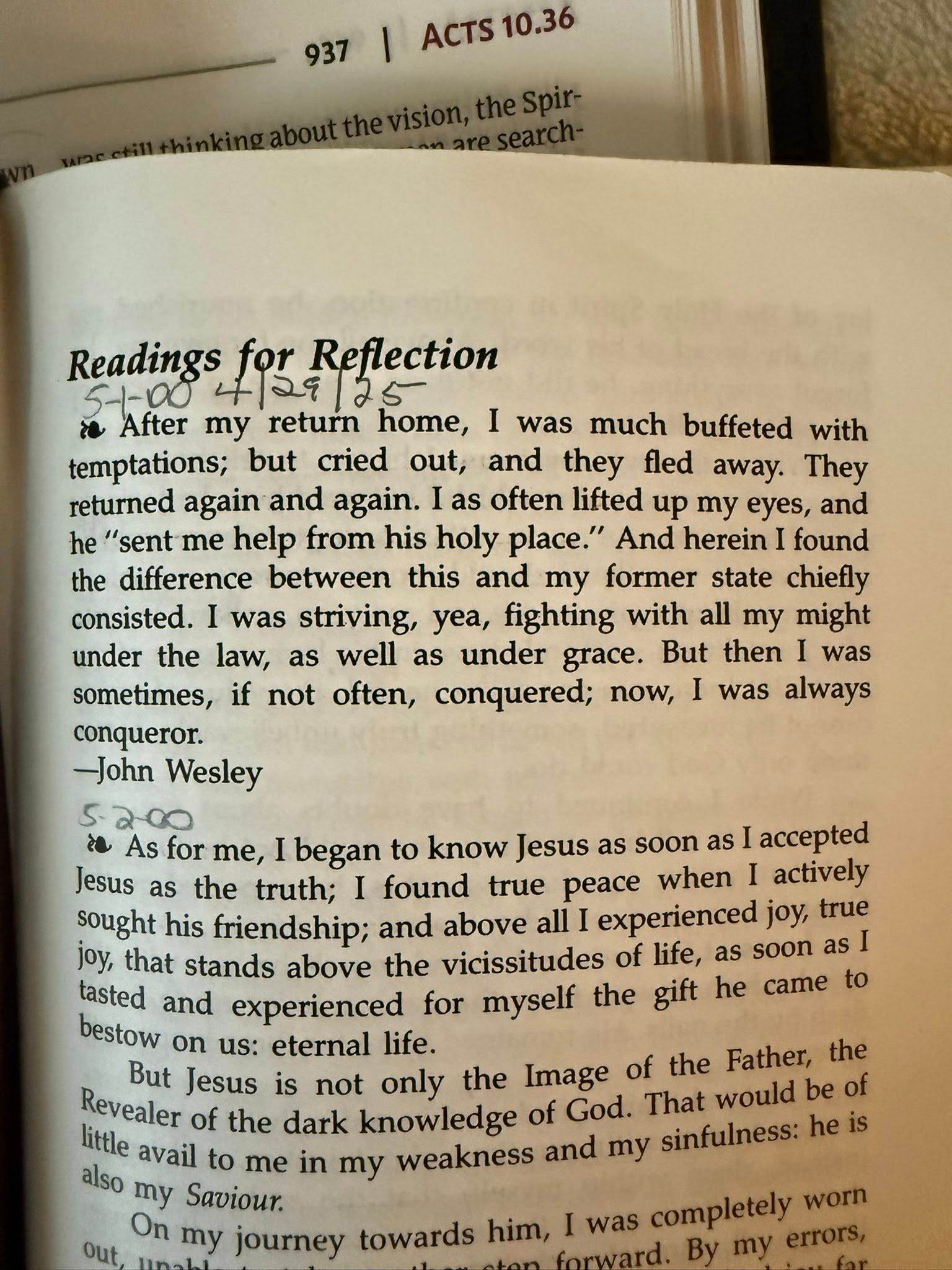
Wesley understood grace not as a single moment but as a journey. Prevenient grace goes before us — it is the grace that draws every person toward God before they know to seek him, the reason no one is beyond reach and no door is permanently closed. Justifying grace meets us at the moment of repentance and faith, forgiving sin and restoring relationship. And sanctifying grace — the grace Wesley considered the great distinctive of the Methodist movement — continues the work, forming us progressively into the likeness of Christ. Grace doesn't simply pardon. It transforms. That is the Wesleyan conviction, and it is the reason discipleship is not optional — it is the normal expectation of the justified life.
The Means of Grace
We are called to live a sacramental life through which God conveys grace to the soul. Word and Sacrament, prayer, fasting, Scripture, and Christian conferencing — practiced as a regular rule of life — form the disciple in ways that no program can replicate. These are not optional supplements to the spiritual life. They are the ordinary channels through which God does his forming work.
Personal and Social Holiness
Wesley insisted that there is no holiness but social holiness. The faith that forms the inner life must also shape the outer life — in the family, the neighborhood, and the world. Personal holiness is not private pietism. It is grace transforming a person from the inside out until that transformation becomes visible in how they love the poor, the stranger, and the forgotten. The Global Methodist Church holds this at the center of its mission: to spread scriptural holiness across the land. That is not a program. It is a way of being human, redeemed.
The Urgency of Witness
The gospel is good news for the world, and the church exists to carry it there. But evangelism divorced from discipleship produces converts without roots. The urgent work is not simply to get people in the door — it is to form them into disciples who, by their very lives, become the witness. The church evangelizes best when it forms disciples well.
The Necessity of the Church
There is no solitary Christianity. The body of Christ is not a metaphor — it is the form that discipleship takes in the world. Formation happens in community, through accountability, and across the generations.